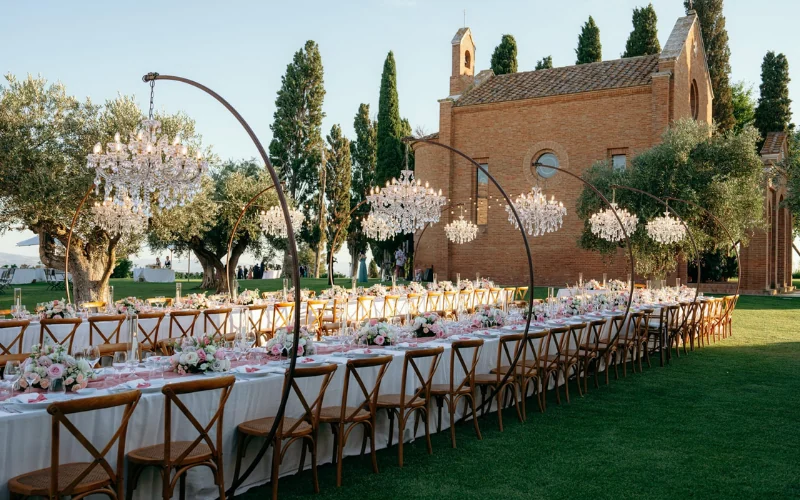
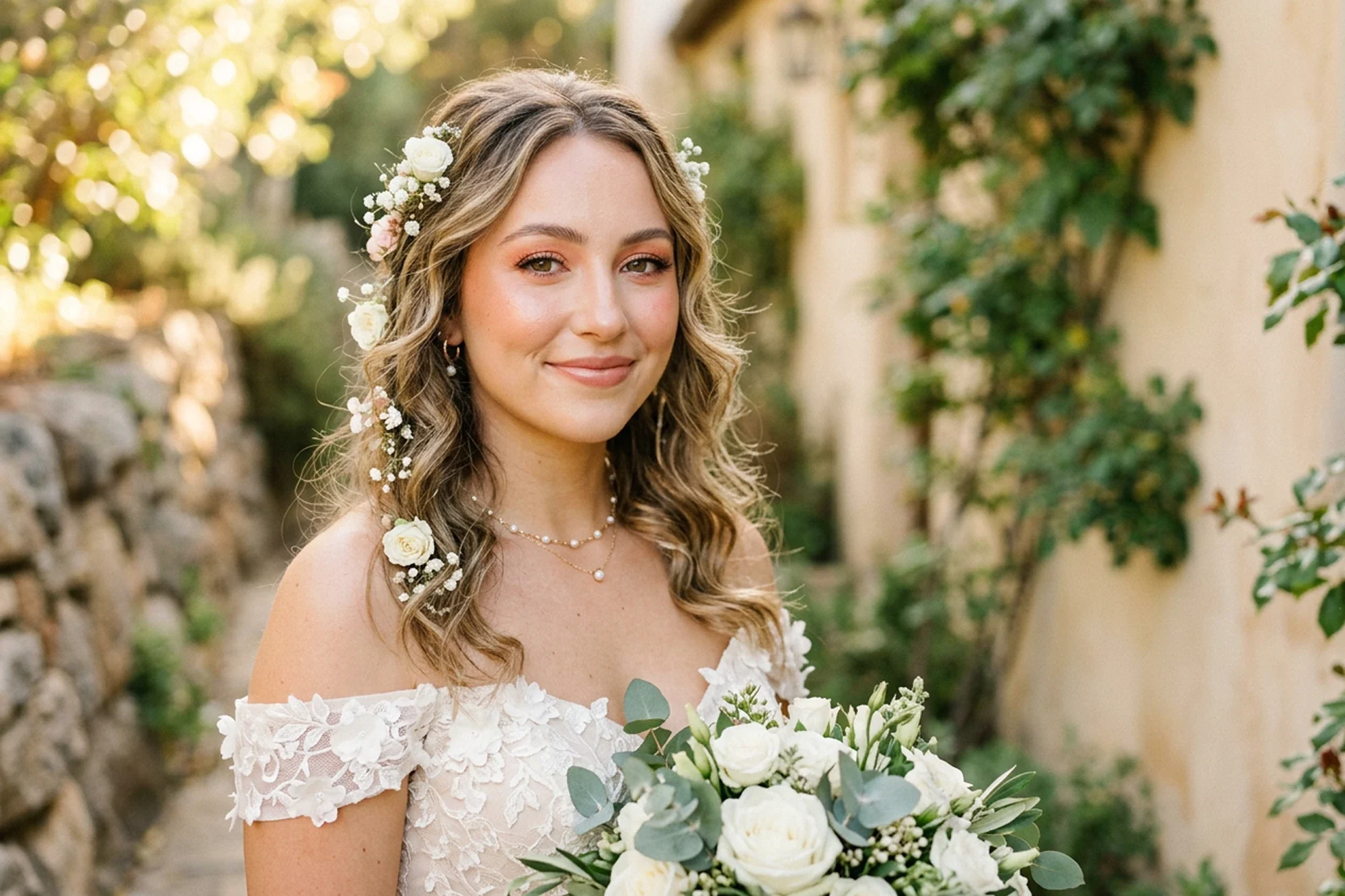
Ask any couple what they remember about a wedding they attended, and it is rarely the napkin folds. It is the moment the dancefloor filled, the saxophonist who appeared during the drinks reception, or the photo strip that is still stuck to their fridge two years later.
Entertainment is the part of the day that turns a beautiful wedding into a brilliant one. It is also the part most often left until last, when the budget is tight and the good suppliers are already booked. If you are marrying in 2027, your timing is good. You are far enough out to have the pick of the best suppliers, and close enough that the popular ones are already taking bookings for your date.
We plan and run weddings across the Costa del Sol, Spain, Portugal, Gibraltar, Greece and the UK, and we are on site for the whole day. This guide sets out what we see working, when to use it, roughly what it costs, and the practical details that catch couples out.
Start with the timeline, not the shopping list
The most common mistake we see is booking entertainment as a wish list rather than a schedule. Couples fall in love with four good ideas and stack them into the same two hour window, so guests only really experience one of them.
A wedding day has four natural phases, and each one needs something different:
- The ceremony: emotional, quiet and focused
- The drinks reception: social, wandering, and the longest lull of the day
- Dinner: seated, captive and easily flattened
- The evening: high energy and dancefloor led
Plot your entertainment across those four windows and the day builds. Stack it all into the evening and you have paid for things nobody used.
Ceremony music
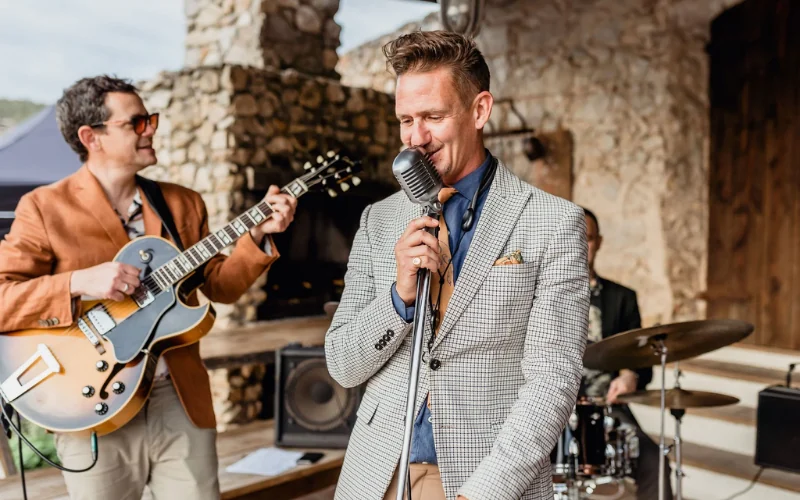
Live music does more work here than anything else. It covers the silence while guests are seated, gives the processional real weight, and signals that the day has begun. A solo guitarist or singer is warm, portable and by far the most flexible outdoors. A string duo, trio or quartet is the classic choice for villa and church ceremonies, and the sound carries beautifully in a courtyard. A harp or solo cello is striking in historic venues and in stone or tiled spaces.
Expect roughly €400 to €900 for a soloist, and €700 to €1,500 for a string ensemble. Our Gold package includes a musician for the ceremony and drinks reception, and Platinum includes a live band or DJ with a saxophonist, so it is worth comparing before booking each element separately.
One practical note for outdoor ceremonies in Spain: wind is the enemy of acoustic music. On beach and clifftop settings a soloist through a small powered speaker will always beat an unamplified quartet that half your guests cannot hear. We check the prevailing wind on site visits for exactly this reason.
The drinks reception, the window most couples underuse
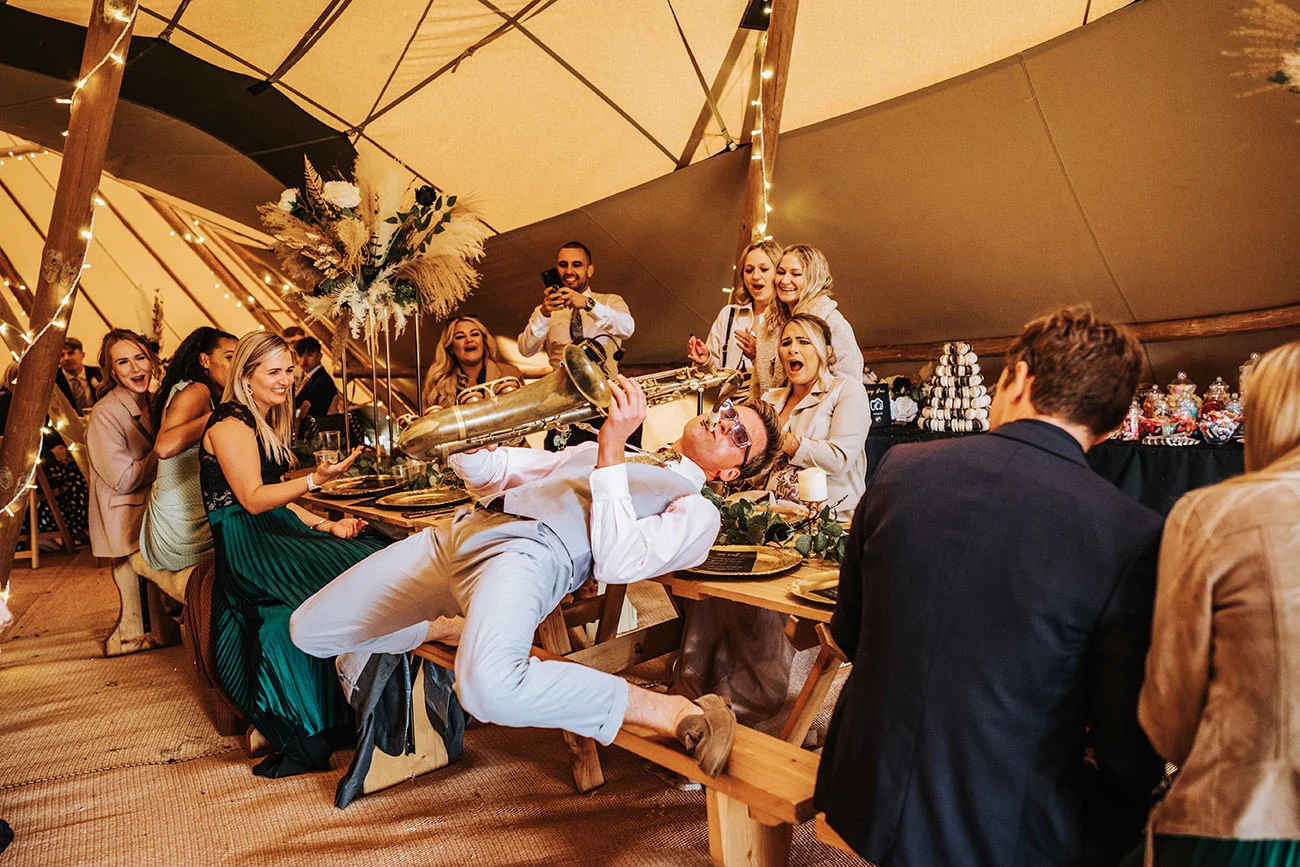
Your drinks reception usually runs ninety minutes to two hours while you are away having photographs taken. Guests are standing, drinking on empty stomachs, and often meeting each other for the first time. It is the easiest part of the day to get wrong, and the easiest to lift.
- A saxophonist alongside a DJ, the format that has dominated Mediterranean weddings for several years, because it fills the space without demanding attention
- A roaming magician, genuinely effective at breaking up groups who do not know one another
- A flamenco guitarist or duo, a nod to the setting that international guests love
- Garden games such as giant Jenga, croquet or boules, inexpensive and excellent for children and for guests who dislike mingling
- Your photo booth opened early rather than at ten o'clock, which roughly doubles how much it gets used
Budget around €500 to €1,200 for a saxophonist and DJ together, and €400 to €800 for a roaming magician.
Mobile bar services
The bar is the one thing your guests stand in front of all day, which makes it the most underrated piece of entertainment at a wedding. Mobile bar services turn a functional queue into something people actually enjoy, whether that is a horsebox bar in a corner of the garden, a copper cocktail cart during the reception, or a bartender who shakes drinks in front of guests rather than pouring them out of sight.
A few things make mobile bar services work harder for you. Keep the menu short, because four well made cocktails move faster than twelve and the queue never builds. Give one or two of them names that mean something to the pair of you, as a signature drink starts more conversations between strangers than any amount of background music. And position the bar so guests pass the entertainment on the way to it, since the bar sets the traffic pattern for the whole reception.
Expect roughly €800 to €2,000 for a staffed mobile bar depending on the length of service and the drinks list, and note that our Platinum package already includes a four hour open bar.
Dinner, where less is more
Dinner is where enthusiasm causes trouble. Guests want to eat, talk and hear the speeches, and anything competing with those three things becomes an irritation however good it is.
Keep it light. A background acoustic set or a curated playlist at conversation volume works well, and a single surprise between courses lands better than a running programme. Singing waiters remain a real crowd pleaser, and the reveal works best when even the wedding party does not know. What we would avoid is a full band during the meal, anything that requires the room to face one direction for more than ten minutes, and speeches placed after guests have been sitting for three hours.
Singing waiters typically cost €600 to €1,200. Background music is often included in your DJ's package.
The evening, where the budget should sit
This is where most of your entertainment spend belongs, because it is where most of the memories are made.
DJ or live band
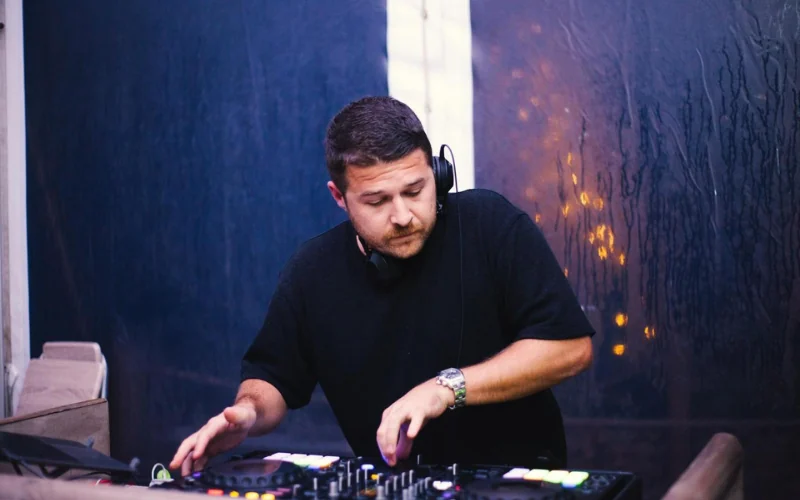
Neither is better. They solve different problems. A DJ gives you range, moving from Motown to reggaeton to nineties dance in three tracks and reading the room as it changes. For the international guest lists most of our couples have, that adaptability matters enormously, and a DJ who knows the room will keep a mixed nationality crowd dancing far longer than a band working through a fixed set list. A live band gives you spectacle instead, and for a certain kind of party there is no substitute for it.
Every supplier she recommended was exceptional, and our wedding day flowed perfectly from start to finish.
A DJ is usually €600 to €1,500, and a live band €1,800 to €4,000 or more.
Booths, mirrors and backdrops
These earn their place because they send guests home with something. A classic photo booth is enclosed and prints strips, and suits a crowd that enjoys the privacy and the props. A magic mirror is full length and interactive, guests can sign the screen, and it draws a crowd because everyone can see what is happening. A 360 video booth films guests in slow motion from a rotating arm, and it is comfortably the strongest performer for social sharing.
The mistake to avoid is placement. A booth in a side room gets a fraction of the use of one sited in the flow between the bar and the dancefloor. We place these deliberately rather than wherever the power socket happens to be. A flower wall or shimmer wall does a similar job, creating a destination that guests photograph themselves against and giving your booth or first dance a finished backdrop rather than a bare wall.
Photo booths and magic mirrors run around €400 to €800, a 360 booth €400 to €700, and a flower wall €250 to €500.
Late night moments
The last hour needs a lift, or the party dwindles rather than ends. Cold sparklers and indoor fountains are dramatic and permitted at far more venues than traditional fireworks. Late night food is entertainment in disguise, and a hog roast, a churros cart or a pizza oven does more for the final hour than another playlist. Keeping one mobile bar open for that last hour matters as much as the food does, because a closed bar empties a dancefloor faster than a bad playlist. A sparkler exit or lantern send off works beautifully, though it is worth checking your venue's fire policy first, as many Andalusian venues restrict open flames through the dry season.
The Spanish details that catch couples out
Music curfews are real and they vary. Noise limits are set at municipal level and by each venue's own licence, so two venues twenty minutes apart can have very different cut off times. Private villas are often stricter than commercial venues rather than more relaxed, because they sit in residential areas. Confirm your curfew in writing before you book a band, not after.
There are exceptions, and they are worth knowing about. Casa de la Era near Marbella has no sound curfew at all, which is genuinely uncommon on this stretch of coast, so the celebration can run late into the night. If a long party matters more to you than anything else on the list, choose the venue around that first.
Power is not a given either. Villa and finca weddings frequently cannot support a full DJ rig, a booth, lighting and catering equipment at the same time. Either the supply is checked properly in advance or you hire a generator, and we work this out at the site visit stage. Some venues are built for it, and Casa de la Era has three phase power and a rooftop DJ booth, which removes the problem entirely.
Heat changes the schedule. In July and August nobody dances at eight in the evening in thirty two degrees, so push the energy later, keep the drinks reception shaded and plan the dancefloor for after sunset. Sound behaves differently outdoors as well. Open air dancefloors need more speakers rather than louder ones, or guests at the edges drift away and the party shrinks.
Your booking timeline for 2027
Entertainment suppliers work first come, first served, and the good ones hold a single date at a time.
- 12 to 18 months before: secure your headline act, whichever it is. For high summer 2027 that means now rather than later
- 9 to 12 months: book your ceremony musicians and your reception act, as saxophonists and flamenco duos are in real demand through the summer
- 6 to 9 months: lock in booths, mirrors, 360 platforms and backdrops
- 3 to 6 months: confirm late night extras, agree set lists and first dance arrangements, and get your venue's curfew in writing
- The final six weeks: share the running order with every supplier so arrivals, set up and sound checks are coordinated rather than improvised
If your date is a Saturday in June, July or September 2027, compress all of that. Those dates go first every year and they are already moving.
What to budget
As a working guide, entertainment tends to account for eight to twelve per cent of a total wedding budget. A modest set up of a DJ and one booth comes to roughly €1,000 to €1,600. A mid range plan with a ceremony musician, a saxophonist and DJ for the reception, an evening DJ and a magic mirror sits around €2,500 to €3,500. A full programme with a live ceremony ensemble, a roaming magician, a band and DJ, a 360 booth, a flower wall and late night food runs from €6,000 upwards.
All of these figures are indicative for the region and vary with season, travel and set length. Peak Saturdays and August carry a premium. Worth knowing for a 2027 date: most suppliers review their rates annually, so a quote taken today may not hold. Ask whether the price is fixed on signature or subject to revision, and get the answer in the contract.
A quick check before you book
Is something happening in each of the four phases of the day? Have you left dead air anywhere longer than twenty minutes? Does anything compete with the speeches? Is every element within reach of power and inside the venue's noise licence? And would your least outgoing guest enjoy at least two things on the list? If the answer to all five is yes, the day will flow.
Entertainment is the element couples most often ask us to fix late in the process, and the one with the biggest effect on how the day feels. We book, brief and manage every supplier on site, so nobody is chasing a DJ for a sound check on their wedding morning. Have a look at our entertainment options, or get in touch for a relaxed, no obligation chat about your day.