Every couple who books a beach wedding pictures the same photograph. Bare feet, sea behind, hair moving gently in the breeze. What nobody pictures is the moment forty minutes before the ceremony when the breeze turns into a headwind and a style that looked perfect in the hotel room is being pinned back together in a beach club toilet.
We coordinate coastal weddings across Spain, Portugal, Italy, Greece, Malta, Cyprus and the UK, and we are on site from the moment hair and makeup begins. This guide is about what actually happens to hair at a beach wedding, which styles survive it, and how to plan the morning so you are not fixing anything at all.
What a Mediterranean beach does to hair
Four things are working against you, and only one of them is the wind.
- Wind, which at most coastal venues is a steady onshore breeze building through the afternoon rather than sudden gusts. It pulls at anything loose and it always comes from the same direction, which matters when you decide where to stand
- Humidity, which sits between sixty and seventy per cent through the summer across most of southern Europe and is what actually undoes a blow dry. Curls drop, straightened hair swells, and both happen gradually across the afternoon rather than all at once
- Salt in the air, which adds grip and texture. This is genuinely useful for braids and updos and unhelpful for anything meant to look sleek
- Heat, because at thirty degrees you will be warm at the roots within twenty minutes, and hair against the neck becomes uncomfortable long before the speeches
Read those together and the conclusion is fairly clear. The styles that work on a beach are the ones that are secured at the base, textured rather than smooth, and lifted off the neck.
Which beach wedding hairstyle actually holds
Read the conditions above together and the same three answers keep coming back. Below are the styles we see survive a full day outdoors, and the ones that need constant attention.
The bridal updo and low chignon
A low chignon or a soft twisted bun at the nape is the most reliable choice we see. It is anchored, it photographs well from behind during the ceremony, which is where most of your guests are sitting, and the salt air actually helps it hold.
Braided and plaited wedding hair
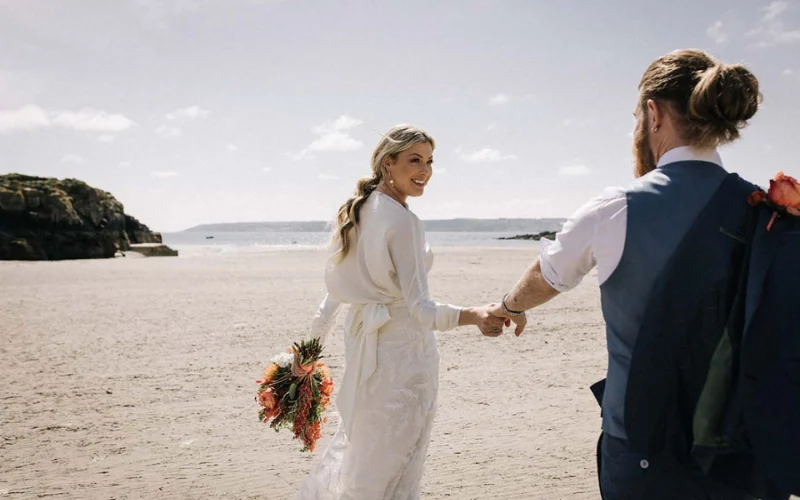
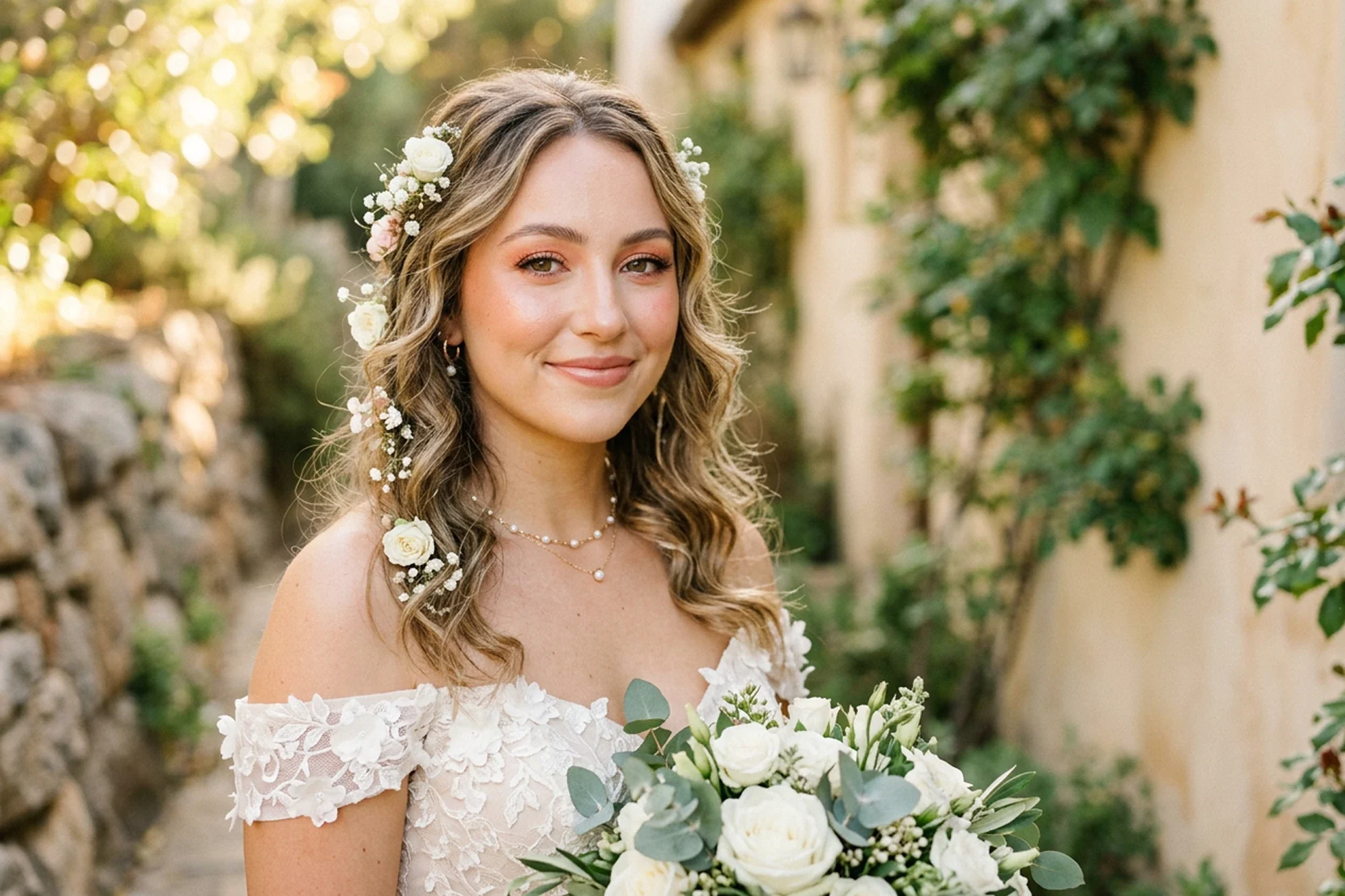
Braided and plaited styles are the other strong option. A loose side plait or a braided crown keeps texture without giving the wind anything to lift, and it looks intentional rather than tidy, which suits a beach far better than a formal set.
Half up half down, and hair worn loose
A half up half down wedding hairstyle can work beautifully, but only if the lower section is meant to move. If it is set in curls that need to hold their shape, humidity will take them out by the drinks reception.
Frizz is the other half of this. In high humidity, hair that has been chemically or heat straightened swells at the cuticle through the afternoon, which is why a style that was smooth at eleven looks soft by four. A light anti humidity serum before styling does more than any amount of hairspray afterwards.
What struggles: hair worn fully down and straightened, high volume at the crown, and anything relying on curl that has been created with heat rather than built into the structure of the style. None of these are impossible, they simply need more product, more pins and more maintenance than most brides want to think about on the day.
Your veil is a wind problem
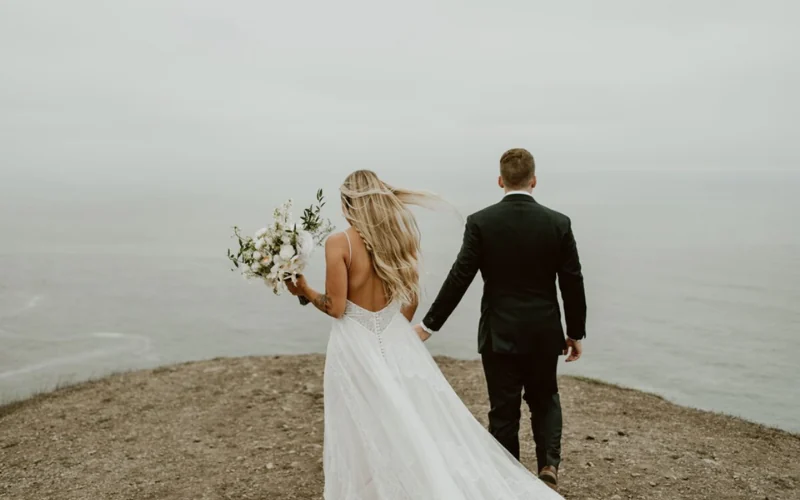
This is the detail couples most often overlook, and it causes more trouble on a beach than the hairstyle itself.
A veil is a sail. On an open beach a cathedral veil will lift, wrap around you and cross in front of your face during the ceremony, and it will do so at the exact moment your photographer is shooting the vows. A fingertip veil or an elbow length veil behaves far better in the same conditions, and a birdcage or short blusher barely moves at all.
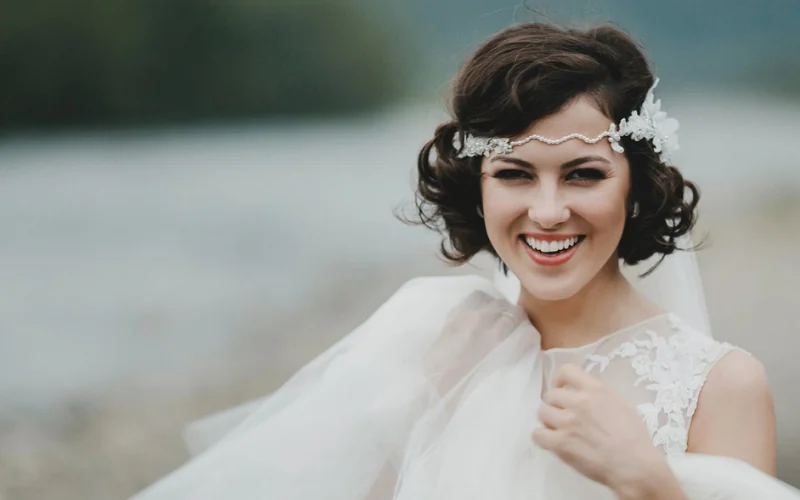
Where the comb sits matters as much as the length. A veil secured underneath a low bun, with the weight of the hair above it, holds considerably better than one pinned high at the crown with nothing anchoring it. Ask your stylist to build the veil into the style rather than adding it at the end.
It is also worth deciding in advance when the veil comes off. Most of our brides remove it after the ceremony and before the drinks reception, which is the point at which it stops being a beautiful detail and starts being something you are managing. Tell someone in your wedding party that this is their job, and it happens smoothly.
Bridal hair accessories for a beach wedding
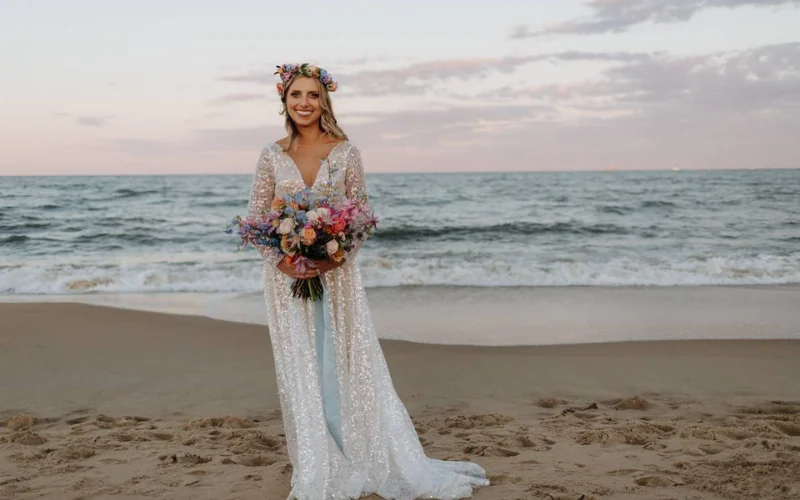
Fresh flowers wilt quickly in this heat, so if you want flowers in your hair use hardy stems and have them placed as late as possible, or use dried or preserved ones instead. Combs, pins and simple pearl or gold detailing all hold up well and photograph cleanly in bright coastal light. Anything heavy will work loose as the day goes on.
Getting the timing right
The running order we build for a beach wedding usually starts hair and makeup at around ten in the morning for an afternoon ceremony. Beyond that, a few things consistently make the morning calmer.
- Have your hair done before your makeup where your stylist agrees, since heat from tools and the movement of an updo can disturb a finished face
- Go last, not first, among the bridal party. Your style should be the freshest when you walk down the aisle
- Allow a genuine hour for the bride, and thirty to forty minutes per additional person. Rushing the last person is how mornings unravel
- Get ready in air conditioning, but step outside for five minutes once you are finished. It is far better to discover a problem then than at the ceremony
- Ask your stylist to leave you a small kit of matching pins and a travel hairspray, and give it to whoever is carrying your bag
What bridal hair and makeup costs
Prices vary by country and by how much of your party is being styled, but the shape of the numbers is fairly consistent across the destinations we work in.
- Bridal hair alone, on the day: roughly €150 to €300 in Spain, Portugal and Greece, and £150 to £350 in the UK and Ireland
- Bridal hair and makeup together: roughly €280 to €500, and £280 to £600 in the UK
- Bridesmaids and mothers: €70 to €120 per person for hair, usually less when booked as part of the same call out
- Trials: commonly €80 to €150, and often deducted from the final balance if you go on to book
- Early start or travel supplements: €50 to €150 where a stylist is travelling to a rural venue or starting before seven in the morning
Those are indicative figures for guidance and they move with season, location and the size of your party. A stylist travelling an hour to a countryside finca will price differently from one working in a city hotel. We build the real numbers into your budget when we source your suppliers.
Trials, and how to run one from another country
Most of our couples plan from the UK or Ireland, which makes a traditional trial awkward. Three approaches work.
Do the trial at home with your own stylist, photograph the result from every angle in daylight, and send those photographs to your stylist at the destination as the brief. This is the most reliable option and the one we recommend.
Alternatively, arrive two or three days early and trial on the ground. This works well if you are already coming out for a welcome dinner, and it has the advantage of trialling in the actual climate.
A video call trial is the weakest of the three but better than nothing, and it is worth doing if you are pairing it with photographs of your hair in its natural state, not just inspiration images of other people.
Whichever route you take, send your stylist a photograph of the back of your head. Almost every reference image couples send is taken from the front, and the back is what your guests will look at for the length of the ceremony.
How to brief a stylist properly
The most useful brief is not a mood board. It is a short, specific note covering the things a stylist cannot guess: whether your hair holds a curl, how it behaves in humidity, what you have had done before that you disliked, whether you are wearing a veil and where it sits, the neckline of your dress, and the time you need to be finished.
Add the setting to that. A stylist who knows the ceremony is on open sand at four in the afternoon will build something different from one who assumes a sheltered garden. If you have booked through us, we brief them on the venue conditions ourselves, because we have usually stood on that spot.
Every little detail reflected us as a couple, and the whole day felt relaxed, elegant and full of joy.
Choosing a setting that suits your hair
This sounds backwards, but it is worth saying. Beach venues vary enormously in exposure. A ceremony on open sand at a beach wedding venue is a very different proposition from one on a sheltered terrace at a sea view venue, where you get the same photographs with a fraction of the wind.
If your heart is set on a style that needs calm conditions, choose the second. We will happily walk you through which settings are exposed and which are protected, whether you are looking at Spain, Portugal, Italy, Greece or the UK, because it changes what is possible for hair, veils, candles and a good deal else besides.
On the day itself
Two practical things, both of which we handle when we are running your day.
Build ten minutes of shade into the timeline between getting ready and the ceremony. Standing in direct sun in full styling for half an hour beforehand undoes more than the wind does.
And agree with your photographer where you will stand relative to the breeze. Hair blowing across the face is the single most common reason a ceremony photograph does not work, and it is entirely avoidable if the aisle is oriented sensibly. This is a conversation we have with the photographer and the venue at the planning stage, not on the morning.
Hair is a small part of a wedding day and an outsized part of how you feel in the photographs. If you would like us to source and brief your stylist alongside the rest of your suppliers, that is part of what our wedding planning service covers, and our on-the-day coordination team is there through the morning to keep the schedule moving. Get in touch and we will talk it through.